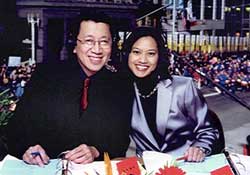
It was four years ago ?back in 4695 ?when I was hired to co-host the telecast of the San Francisco Chinese New Year Parade on KTVU. Having survived one co-anchor change and the Y2K bug, I'm set to help describe the parade again, this time on February 19, to bring in the Year of the Dragon. The following article, originally written for
KTVU's Web site, is a recollection of my first time in the TV tent (or "broadcast position," as it's called in the biz).
It was February, 1997, the year of the ox. Last year (tiger), KTVU's award-winning reporter Thuy Vu signed on as co-host, replacing the departed Elaine Corral. Vu, who was born in Saigon, is one of the brightest young broadcasting talents in Northern California ?in the entire industry, in fact ?and we had a blast, riding the tiger.
Here's how my first ride went.
The first explosions jolted Elaine Corral, the co-anchor of the nightly newscast on San Francisco's KTVU. But it was just firecrackers. Workers on the Embarcadero end of Market Street were beginning the process of carpeting the boulevard with the red shreds of paper from burnt firecrackers. It was the first of many explosions to come.
Sitting next to Elaine, I was no less jittery. We were trying to rehearse for the station's coverage of the Chinese New Year Parade. Elaine, of course, is a pro anchor. But, for a co-host, she was being saddled with a first-timer: me.
Sure, I've done some time on the tube, but usually as a subject of interviews, and usually when the subject is the death of a rock star. But co-anchoring a live event?
Reading from a TelePrompter? Describing floats?
It was all new to me.
When KTVU invited me, however, I couldn't say no. After all, who doesn't love a parade? Actually, not me. At least, not live. For years, I've avoided going to the parade, far preferring to catch it on television. You can't beat having both volume and crowd control, all from your couch.
Still, you don't turn down a plum assignment. I'd get to work with Corral; I'd probably have a pretty good view of the festivities, and, as part of my research, I might finally figure out the difference between hoy neen and hawn neen. That's one (or two) of those things I grew up with, in a Chinese-American family, without knowing their meanings.
While I did my research, the KTVU and Chinese New Year Parade teams were hard at
work. Preparation for a typical parade begins six months ahead of time; the station has a writer at work three weeks before, gathering information from the participating groups and meeting constantly with David Lei of the Chinese Culture Foundation, other parade coordinators, and KTVU producers and directors.
In the days before the parade, Elaine and I attended two script-reading sessions at the
station, and that was it. Our next meeting would be in the broadcast tent on Market Street, where we'd get a few minutes for rehearsals, and where I'd see and try out a TelePrompter for the first time in my life.
As it turned out, the Prompter would only come into play at the top and bottom of the two-hour show. Besides, there were plenty of other things to worry about. Just 11 minutes
before air time, for example, the monitors, on which we'd see what was going over the air, went kaput.
Techies scrambled around on hands and knees, shaking and jiggling equipment and cables. "Get the backup generator," someone cried.
Two frazzled minutes later, we got our mini-TVs back. A plug had loosened. Just slightly frayed, we hit the air, I got through the first TelePrompted hellos all right (Elaine,
needless to say, breezed), and we sailed for a few minutes. Then the scheduled order of the parade began clashing with reality. The police chief and the fire chief, who were supposed to be in separate vehicles, were riding together. Script change! The scavenger marching unit, which had four different components, showed up with one we hadn't expected, and the others were out of the scripted order. Ad lib!
Production assistant Bonnie Lee, sitting beside me for just such emergencies, reached over and ripped a page out of my script just as I was getting to it. Other times, she hurriedly ran her pen over chunks of script. Floats, bands and cars fell in and out of order, and Elaine and I simply had to go with the flow. Sometimes, Elaine, used to talking as soon as she got a "Go!" from the director in her headset, would read my lines, and I'd
have to adjust by reading hers.
Before the parade, Elaine had offered some friendly words of wisdom. "This is not going to be fun," she said. "To the audience, it may look like it, but we're going to be working."
We certainly did. And thank Buddha for Elaine Corral. Whenever I froze, she was there with New Year's factoids. I worked in bits and pieces about my childhood love of lion
dancing, about the lunar calendar, and about Chinese New Year traditions I'd clipped from various sources, ranging from Chinatown newspapers to a Tsingtao placemat, and it all worked out fine. The last strings of firecrackers exploded right on time, I gave Elaine a traditional lay see envelope, we wrapped it up, and, afterwards, she still had her hearing.
The next day, we learned that the parade had drawn some 750,000 spectators, and,
later, that the broadcast had also attracted excellent numbers.
Elaine had worn red (jacket) and gold (jewelry) for good luck, and it had worked. Me? I learned that "hawn neen" is the closing of the old year, celebrated on New Year's Eve, and "hoy neen" means "opening the year."
And I can say that my superb co-anchor was wrong. It was fun. Especially the next
day, watching the repeat broadcast with my remote control.
What's not to love about a parade?
Ben Fong-Torres, long-time writer and editor at Rolling Stone magazine, is the author of four books, including his memoirs, The Rice Room: Growing Up Chinese-American, and his latest, Not Fade Away: A Backstage Pass to 20 Years of Rock & Roll. He is Editorial Director of myplay.com, an Internet music site that offers free Web space, where users
can grab, store, mix, play, and share music of all kinds.